

“The President asked President Xi to increase production of refined petroleum products to help stabilise global supply“
WHITE HOUSE FACT SHEET, 25 SEPTEMBER 2026
Merchants,
on 25 September the White House published a fact sheet on the state visit, one line in it I have read more times.
Donald Trump asked Xi Jinping to increase China’s output of refined fuels, to help stabilise global supply.
The largest crude producer on earth was asking its “main rival” to refine more fuel, so that American diesel might get cheaper.
Remember what Trump came back to office promising: cheaper oil, lower interest rates and Gulf money.
In February all 3 looked on track.
Oil was falling, the futures market priced the Fed at under 3% by 2028 and the Gulf states were pledging trillions.
Then the war on Iran began… Today Brent is above 100 dollars, the 10-year Treasury yields close to 5%, and the same futures market prices the Fed at 4.4.
Last week I asked whether OPEC was losing control (article here).
This week the question turns the other way.
All year, Washington has used access to its market and the power of the dollar to decide who sells oil to whom.
All year, it has also had diesel at a record, a Federal Reserve raising rates under the chairman the President chose and a Treasury Secretary buying back old bonds to keep long term yields calm.
Each of those aims makes sense on its own. Put them together and they collide.
The collision runs through Chinese refineries and Saudi crude.
The thing most commentary misses is simple, a barrel of crude does not move a truck.
A refinery has to turn it into diesel and that diesel has to reach the place that is short. More crude does not fix a fuel shortage…More refining does, it uses up more crude while it does it. Hold on to that distinction and the request to Xi becomes the clearest map of the year’s trade-off that any government has published.
One additional hint before we start, the Chinese export recovery Trump asked for had already slowly started in July, 2 months before the summit. He was encouraging something already in motion.
The same data shows the real catch, China’s refineries ran at a record in August partly by drawing down their own stocks, on Reuters’ arithmetic by more than 0.5 million barrels a day.
Stocks are borrowed time, What replaces them comes from the Gulf, and the Gulf is the problem I wrote about last week.
BEFORE WE START, 2 THINGS:
◈ Save this and block 20 minutes this week to read it properly. It is long because the question is.
◈ Share it with anyone who still thinks the dollar story and the diesel story are two different stories.
1) Crude is not diesel
Every argument in this article rests on one distinction, so it goes first.
Crude in a tank is an input.
Diesel in a truck is an output.
Between the two sit a refinery, a tanker, a pipeline and a chain of retail stations. Each has its own capacity, its own price and its own politics.
This matters in 2026 because the shortage that hurts households is in fuels, not in crude. American crude production is at a record. What is expensive is diesel and jet fuel.
The Middle East used to export both in bulk, from refineries that now sit behind a Strait of Hormuz that has been dangerous since February and a Saudi pipeline that drones shut this month.
A government can release crude from a reserve and move the crude price, but it cannot release diesel it does not have.
That is why the request to Xi went to the right country.
China is the world’s largest refiner (with US) and has the most spare fuel making capacity that a government can switch on by decree. When Beijing loosens its export quotas, the world diesel market loosens within weeks. No other government (US+China) controls that lever .
2) What China is actually shipping
The numbers are good.
The timing is better than the diplomacy suggests.
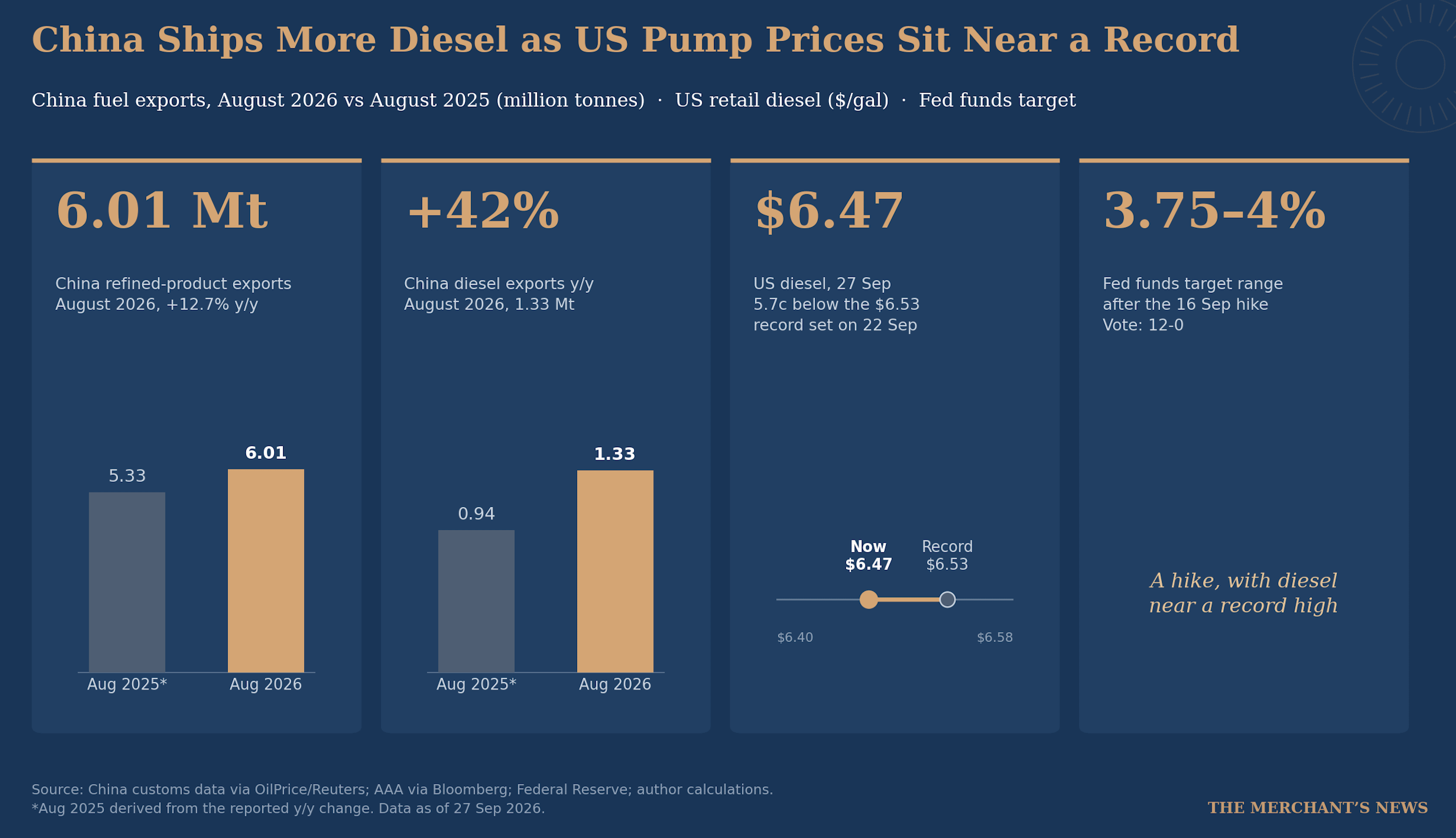
China exported 6.01 million tonnes of refined fuels in August, up 12.7 % on a year earlier. Diesel was 1.33 million tonnes, up 42 % and the most since March 2024. Jet fuel was 2.55 million tonnes, up 41 % and a monthly record.
August was above the level China exported before the Iran war began and that is the comparison that matters. The shortage the world has lived with since February is, at the margin, being filled by Chinese refineries.
The shape of the year matters as much as the August number. China curbed exports in mid March and stopped any cargo not already cleared. The low point came in April and May 3.1 and 3.4 million tonnes in total, with gasoline exports close to zero. In barrels, the 3 clean fuels (diesel, gasoline, jet) went out at about 360,000 a day in May.
By August they were at 1.16 million.
That is a tripling in 3 months. It is also a recovery from a hole… exports from January to August are still 9.6 % below last year, gasoline is down by more than half, and only diesel is ahead for the year.
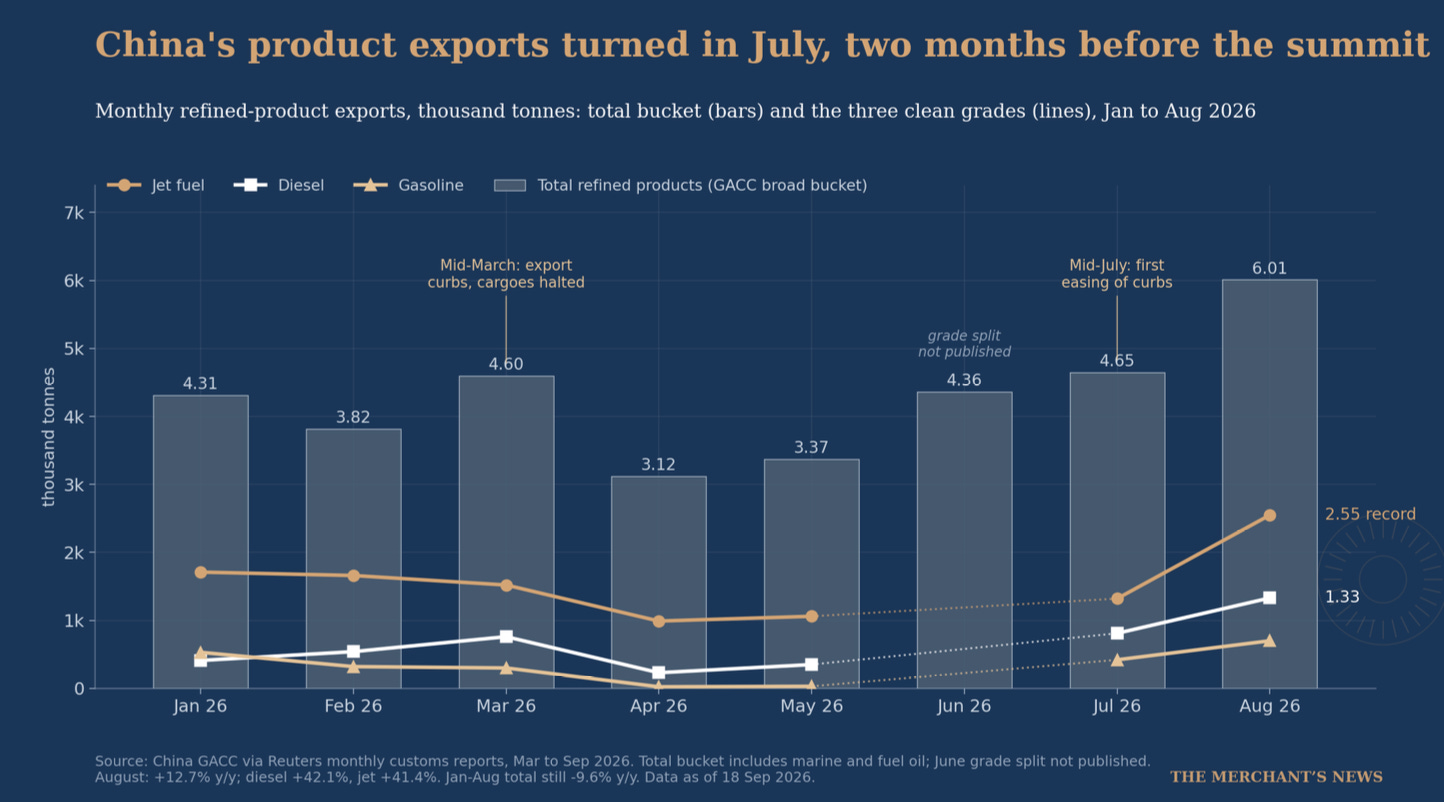
Now the timing, Beijing began easing its export curbs in the middle of July so the August recovery came 2 months before the September summit. Trump did not create a supply response. He encouraged one that had already begun and the White House wording says as much it describes a request, not a Chinese promise of any volume.
That changes what to expect.
If the exports were a diplomatic gift, they could be withdrawn when the diplomacy sours. If they are a commercial response to record fuel margins, which is what the July timing suggests, they will continue for as long as the margins do and China’s own supply allows.
The second reading is more durable and less controllable, and it is the one the data supports.
Chinese refineries processed 13.91 million barrels a day in August. Reuters ran the balance, imports + domestic output minus refinery runs and found an implied stock draw of about 640,000 barrels a day.
That is an estimate, not an official figure China does not publish one, so read it as a direction, not a measurement, but the direction is clear, China is exporting more fuel than its current crude imports support, and it is doing so by running down stocks.
Stocks let a country separate today’s refinery runs from today’s imports.
They buy time….They do not buy it forever.
For September, some sources say the export programme is again at least 4 million tonnes of the 3 fuels, with jet up to 2.4 million and diesel above 1 million; customs will confirm in mid October.
To keep that up, China needs more crude coming in.
Which brings us to Riyadh.
3) The first relief at the pump
The relief is real, it is small, it began before the request was published and it should not be over-read.
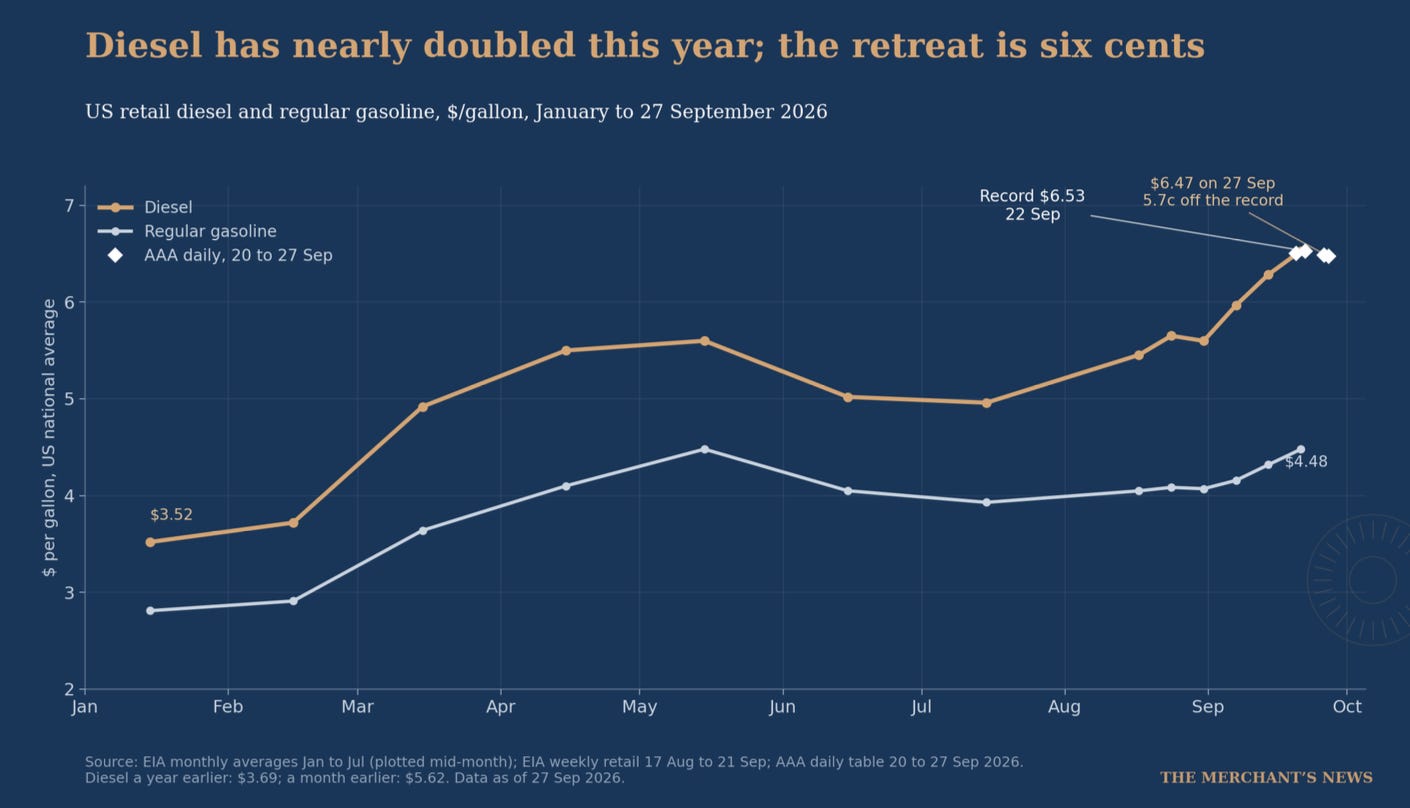
AAA’s national table on 27 September put diesel at 6.47 dollars a gallon.
That is 5.7 cents below the record of 6.53 set on 22 September, and below the 6.51 of a week earlier.
Regular gasoline was 4.48, about where it was a week ago. Put that against the year and the relief shrinks.
Diesel was 5.62 a month ago and 3.69 a year ago, a driver is paying 85 cents more per gallon than in August and 75% more than last September.
This is a first step back from a peak, not a return to normal.
I would be careful about cause and effect. The diesel retreat began after the 22 September record and before the request was published on the 25th. Crude has moved, expectations about Saudi shipping have moved, local stocks and wholesale margins have moved and a daily pump price cannot separate them.
There was a domestic lever too and Washington chose not to pull it.
America exports a lot of diesel. Banning those exports would keep more at home and push the price down quickly, at the cost of every ally who buys American fuel. According to Senator Ted Cruz last week, the White House will not do it.
So the relief has to come from abroad, and abroad means China. What can be said is this Chinese cargoes do not have to land in Houston to matter in Houston. More fuel in Asia means Asian buyers compete less hard for Atlantic barrels and traders carry that effect west. Freight, fuel specifications and port access decide how fast.
The household arithmetic is worth stating because it caps the good news. In simple terms, the wholesale price of diesel is the crude price plus a premium for refining, called the crack spread.
Retail adds transport, distribution and tax.
If Chinese exports shrink the refining premium while the crude price rises, because those same refineries are buying more crude, the pump price can barely move. The plan can succeed on its own terms and still disappoint the voter it was designed for.
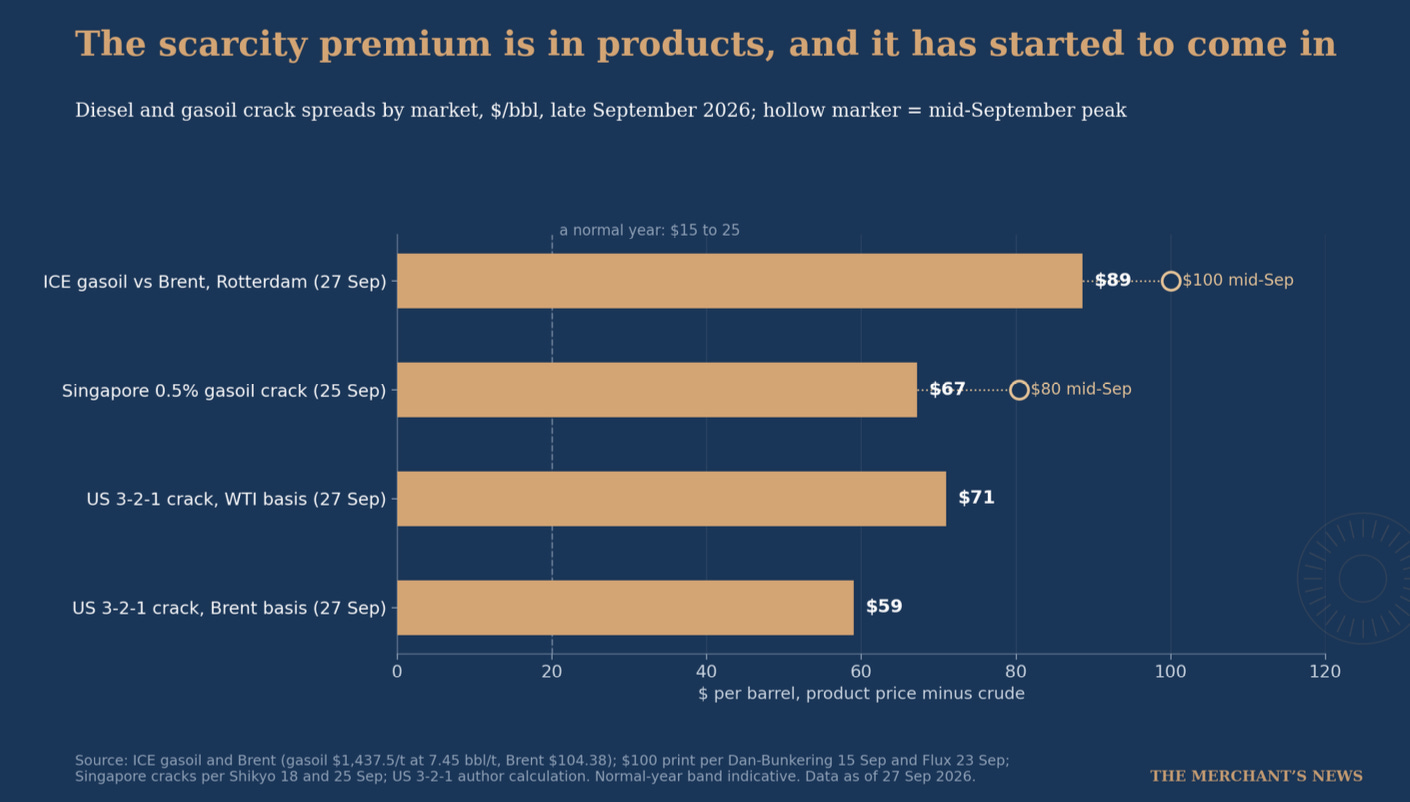
The premium is where to look, and it is already moving. The gap between European diesel and Brent crude traded above 100 dollars a barrel in mid-September, for the first time ever.
On 27 September it was about 89, with Brent at 104.
Singapore’s equivalent has come in from about 80 to 67 in a week. In a normal year the gap is 15 to 25. So the fuel premium is enormous, it has started to shrink and crude has not fallen while it does.
That is the Chinese export effect in one number, and it is landing on refiners’ margins before it reaches anyone’s pump.
4) Saudi crude is the feedstock the plan needs
Last week’s edition argued that the power OPEC is losing this year is the power to put barrels on the market when the market needs them, and that Saudi Arabia’s problem is routes, not reserves.
This week that problem becomes Washington’s. The Chinese refineries Trump wants running harder are among Riyadh’s largest customers.
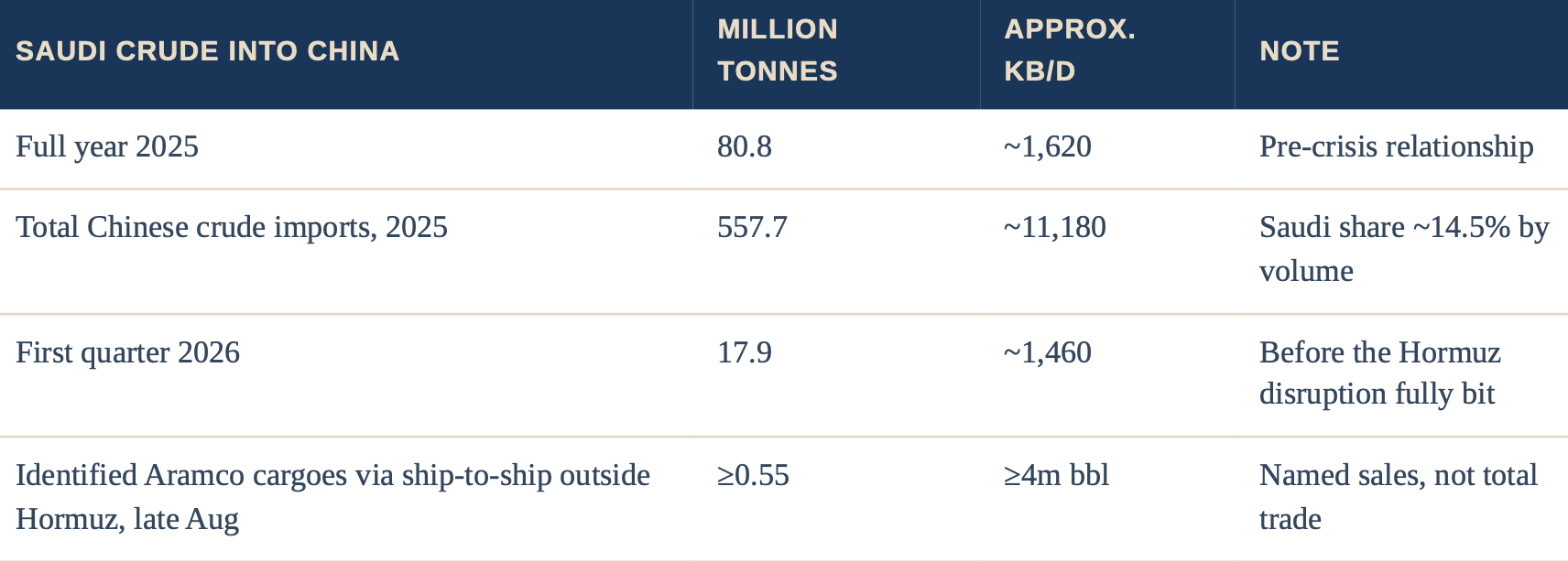
China’s foreign ministry reports imports of 80.8 million tonnes of Saudi crude in 2025 and 17.9 million tonnes in the first quarter of 2026. Against total Chinese crude imports of 557.7 million tonnes last year, Saudi Arabia supplied about 14.5 % by volume. That is the relationship before the crisis. It is not September’s flows, which nobody outside Aramco and the Chinese majors can measure precisely.
What we do know is that the trade has continued under much harder conditions. Reuters reported in late August that Aramco had sold at least 4 million barrels to China by transferring them ship to ship outside Hormuz. Those are identified cargoes, not the whole trade. They tell you the effort both sides are making to move crude around the strait rather than through it.
This week brought better news on the strait itself. Bloomberg’s tanker tracking put Saudi crude exports at their highest since the war began, Qatar’s gas shipments at a 2-month high and Iraq’s oil exports at a post war high for September. Barrels are moving through Hormuz again, under escort and at a price. That is the best news in this article for a Chinese refinery, with two caveats.
The Houthis are attacking Saudi Arabia almost daily, Trump rejected Iran’s 7 day ceasefire offer and the Middle East barely featured in the meeting with Xi. The route is open at the pleasure of a war that is not ending and the American blockade on Iranian oil exports removes the cheap feedstock that China’s independent refineries used to run on. More Saudi crude is arriving just as less Iranian crude can.
The net gain for China’s feedstock is smaller than the headline.
For Washington, that supply is the hinge. Its sanctions plan, which I come to in Section 6, aims to push China and India off Russian crude. That only works without raising prices if there is other crude to buy and the other crude is Saudi.
Spare capacity in Saudi Arabia’s Eastern Province is worth nothing to a refinery in Zhejiang unless the barrels can reach it. On 22 September the Financial Times reported that Riyadh had signalled a restart of the East-West pipeline. Prices moved before a single restored barrel loaded and that is exactly the point. The market is trading Saudi logistics, not Saudi geology.
5) The currency detour
A story went round the trade this week that connects the energy question to the dollar question. Most versions of it are wrong.
The Financial Times reported on 20 September that Saudi Arabia had left mBridge, a cross-border digital-currency project led from Asia. The version that circulated was that Riyadh had stopped taking yuan for oil. That is not what happened…. The Saudi central bank’s own statement says its trial ended on 13 May 2025. It cannot be a reaction to a sanctions law signed in September 2026 and it says nothing about what currency any oil contract is priced or paid in.
3 things get mashed together here, and they are separate.
There is the currency a contract is priced in.
There is the currency it is paid in.
There are the rails the payment travels on.
Leaving one platform is a decision about the rails. It is not a policy on the other two.
The point that survives the correction is the useful one, an alternative payment channel can reduce a country’s reliance on particular banks. It cannot buy access to American customers. If Washington ties tariffs to a country’s purchases of Russian energy, paying for those purchases in yuan does nothing about the tariff. That is the hole in the “dedollarisation” reading of this year. It is also why the tariff and not the sanction, is the instrument to watch.
6) The collision
On 18 September Trump signed the Lindsey O. Graham Sanctioning Russia and Iran Act. It allows tariffs of up to 100% on goods from named major buyers of Russian energy, or from countries that help them evade sanctions.
Whether and how it is applied depends on official determinations and waivers. None of the sources I have reviewed shows a blanket 100% tariff already running against Chinese or Indian goods. It is a power, not yet a tariff.
Hold that next to the request to Xi and the collision is obvious.
Washington is asking China to refine more, which needs more crude, while building a tool to punish China for buying the crude it refines now. If enforcement takes Russian barrels off the world market before Saudi barrels can reach Chinese ports, it raises the price of the very feedstock the extra refining needs. The 2 policies pull the same rope in opposite directions.
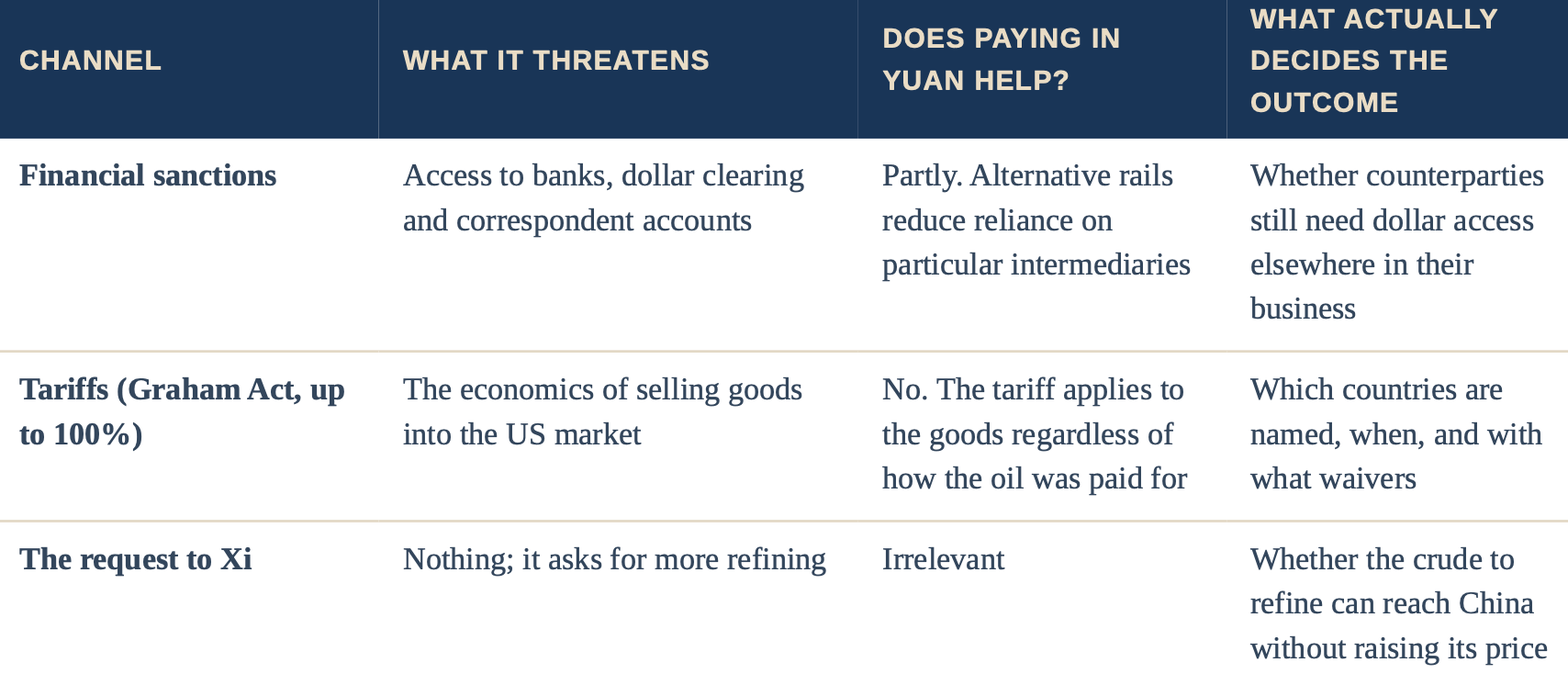
The pressure works through two channels, they should be scored separately. Financial sanctions threaten access to banks and dollar payments. Tariffs threaten the economics of selling goods into America. Paying in a different currency helps with part of the first and none of the second.
The outcome is not fixed.
Since 2022 the pattern has been that trade reroutes, middlemen change and Russia sells at a bigger discount, without the world losing the barrels. The other possibility is that restrictions hurt logistics enough to cut delivered volumes and prices rise.
The following things decide which it is:
how many barrels are actually lost
what price Russia actually gets
what the replacement cargo costs
One number that will be cited as proof the law is working is nothing of the kind. Reuters reported Russian supplies to India down 16.5 % in August, to about 2.1 million barrels a day. That happened before the law and alongside changes in Middle East availability. A government can create pressure before it applies a tariff. It cannot assume the other side responds without changing freight, stocks, discounts or investment somewhere else in the chain.
7) 3 central banks raise rates into an energy shock
On 16 September the Federal Reserve raised its target range by a quarter point, to 3.75 to 4%.
