

Merchants,
Two events, one contradiction…
Inside the US embassy in Muscat, American officials were reportedly trying to keep Yemen’s war from swallowing what remains of Red Sea shipping.
On the other side of the oil market, traders delivered a harsher verdict. Asian diesel margins crossed $87 a barrel, New York diesel futures settled at an all time high and Saudi Arabia started rerouting crude through channels that get more complicated by the day.
Brent, meanwhile, eased back toward $107 after touching $108.
The screen says the risk premium is negotiable.
The refinery gate says the shortage is not.
So the question for this article is whether Washington can buy enough maritime security to stop the oil rally, or whether the disruption has already moved downstream, into a diesel market that no handshake can refill.
What happened in Muscat, and what did not
Reuters, reports that US and Houthi representatives met at the American embassy in Muscat over the weekend, with Oman helping to arrange it. The Houthis are said to have told the Americans they would respect their 2025 ceasefire with Washington and did not intend to attack US vessels; one source added that they would also avoid Israeli and other commercial ships, with one exception.
Saudi shipping.
The State Department has not confirmed the meeting. Everything in this paragraph is anonymous-source reporting about assurances and I will treat it that way: a boundary being drawn around the conflict, not the conflict being ended.
That boundary matters because of what the Houthis now hold.
Many sources confirms Mocha and Perim, the island in the mouth of Bab el-Mandeb; claims about the Hanish Islands come from regional and social sources and I am leaving them out.
With the port and the island, the Houthis have the position to threaten or selectively tax what floats north toward Suez.
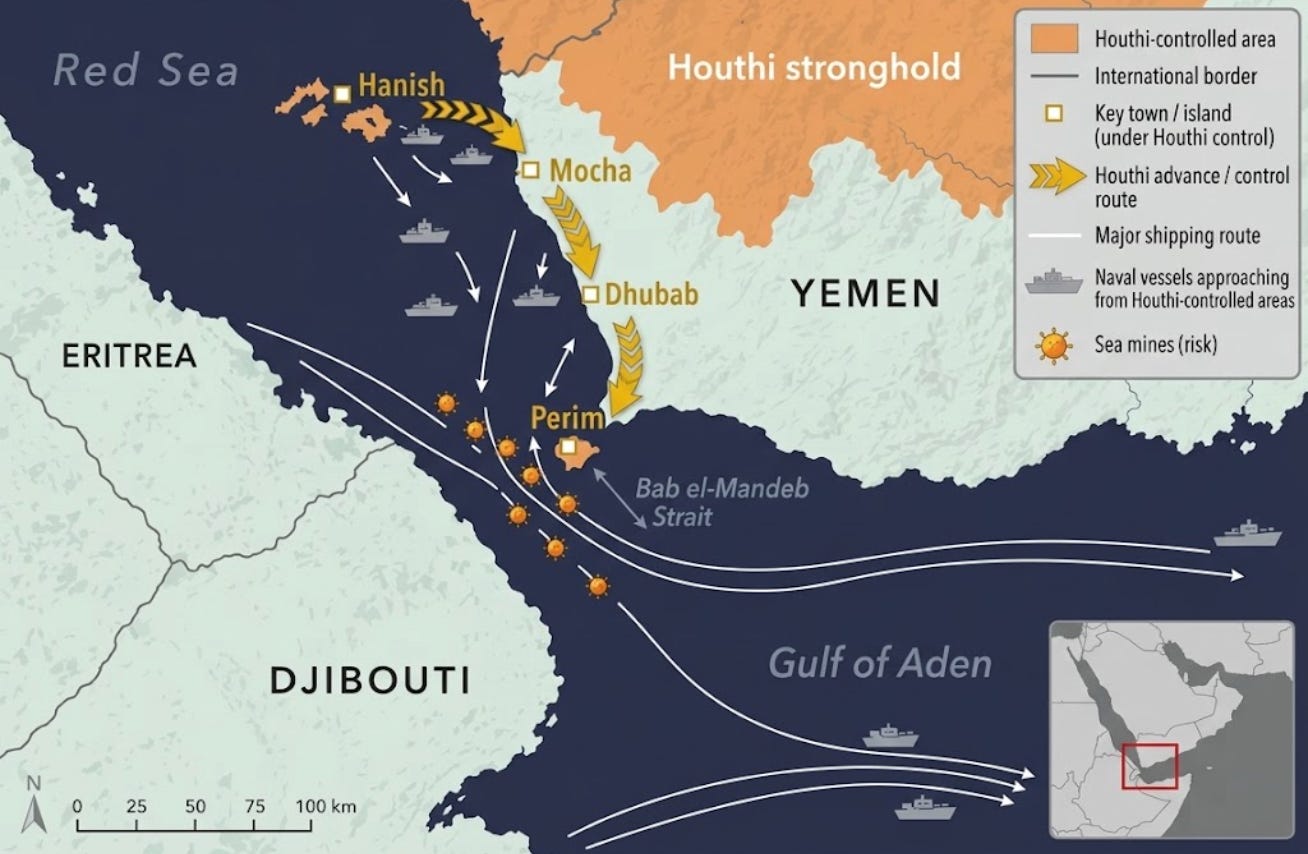
The strait remains open.
The ability to close it selectively is what has changed. A deal that protects American hulls and leaves Saudi ones on the target list protects the wrong ships for the oil market.
Saudi Arabia is the exception, and the problem Saudi crude reaches the sea 3 ways, and this week all 3 are compromised.
Through Hormuz, where traffic collapsed to four vessels on Monday against roughly 125 a day before the war and where Gulf-Iran talks on the strait have just been postponed.
Through the East-West Pipeline to Yanbu on the Red Sea, the route built precisely to bypass Hormuz, which has been offline since a drone attack on 10 September that reporting links to launches from Iraq’s Maysan province; the Saudi energy ministry confirmed “multiple attacks” and a precautionary shutdown, and no crude has left Yanbu since the 11th.
Through Bab el-Mandeb, which any Yanbu cargo bound for Suez must pass, now with a Houthi port and island on its flank. Suez is open and, for the moment, useless: crude has to reach Yanbu before it can sail north. That is why at least 3 European refiners have had September cargoes cancelled or pushed to November, why Poland’s ORLEN is tendering for Grane, Johan Sverdrup, Johan Castberg, WTI Midland and CPC Blend, and why Mediterranean grades are trading at premiums nobody has seen since spring. ORLEN says its refineries face no immediate feedstock disruption. That is what a company says while it is buying everything it can (I tried contacting them at media@orlen.pl, but I haven't received a response yet).
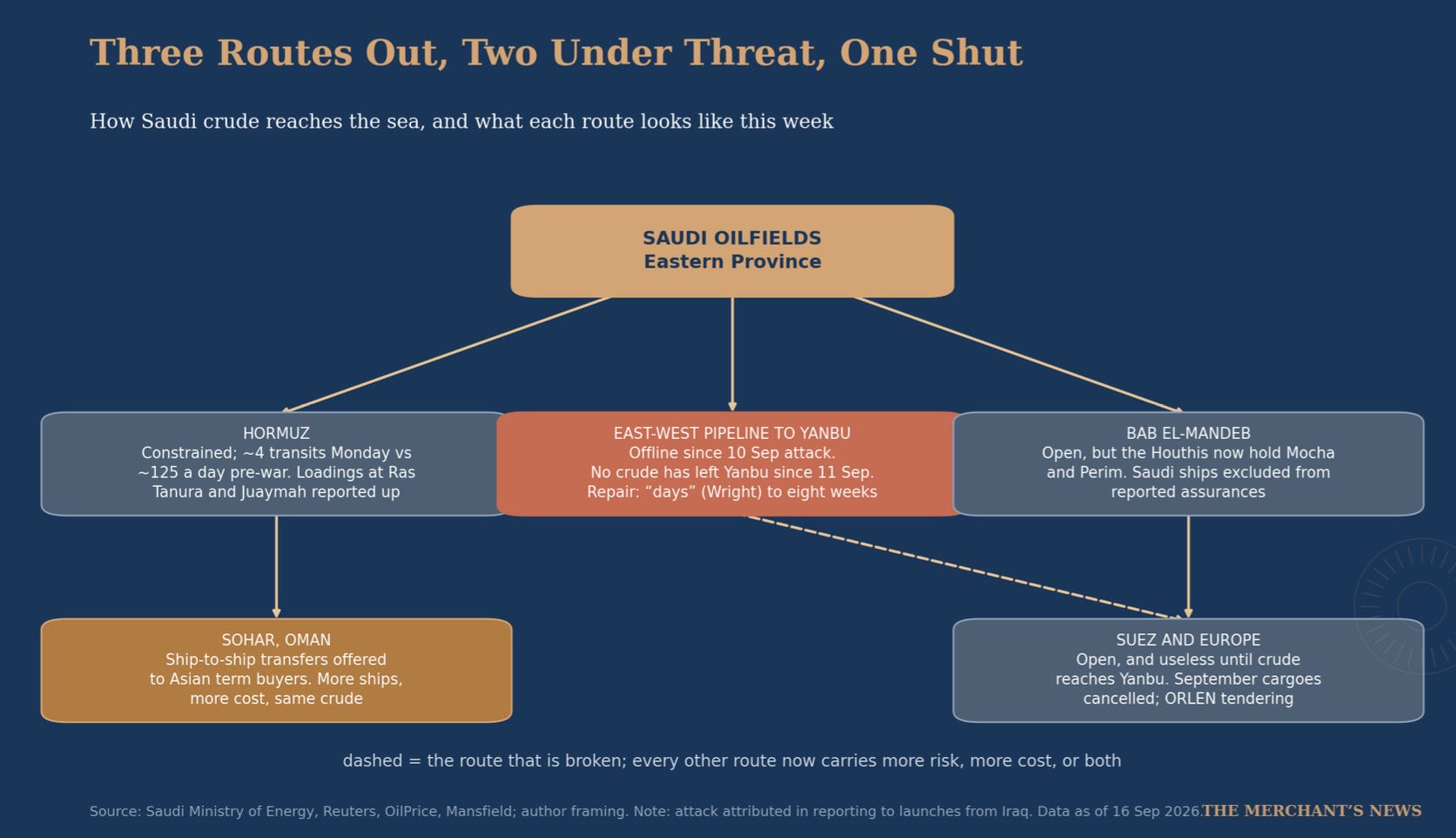
US Energy Secretary Chris Wright expects the pipeline back “in days”. Trading estimates run from imminent to 8 weeks, because a partial restart and the repair of damaged pumping stations are two different jobs, both can be right, so treat his forecast as an official expectation, not as an operational schedule, until Aramco publishes one, and watch Yanbu loadings rather than press conferences.
