

Dear Merchants,
This edition of The Merchant’s News is powered by Trade Data Monitor, a global database of import and export trade statistics that helps you see real flows, spot trends, and answer critical market questions with data. If you want to know more about how they track trade across the world, you can take a look at their website here: Trade Data Monitor

Now let’s jump into the story.
Venezuela just fired the first shot in a battle that could reshape North American oil flows.
February 2026 marked a turning point that few outside Gulf Coast refineries fully grasped.
Venezuelan oil exports surged 60% in a single month from 500,000 barrels per day in December 2025 to 800,000 bpd in January 2026. This was the opening move in a US backed oil reopening that targets more barrels in the coming years.
The market spent weeks obsessing over who gets to produce this oil.
Repsol, Chevron, maybe ExxonMobil. Production stories, joint ventures, PDVSA partnerships.
But production is the easy part.
The real story sits 2,000 miles north, where Canadian heavy crude producers are about to lose $10–14 billion in annual revenue to a competitor they thought was dead. And buried inside that displacement sits an equipment supplier trading at a 45% discount to peers, positioned to capture $2–3.5 billion in infrastructure sales before a single service company gets paid.
This is about geology, logistics, politics and a supply chain that hasn’t priced in what happens when the US Gulf Coast remembers it was built for Venezuelan crude, not Canadian.
Let’s start with what most people get wrong about Venezuela versus Canada.
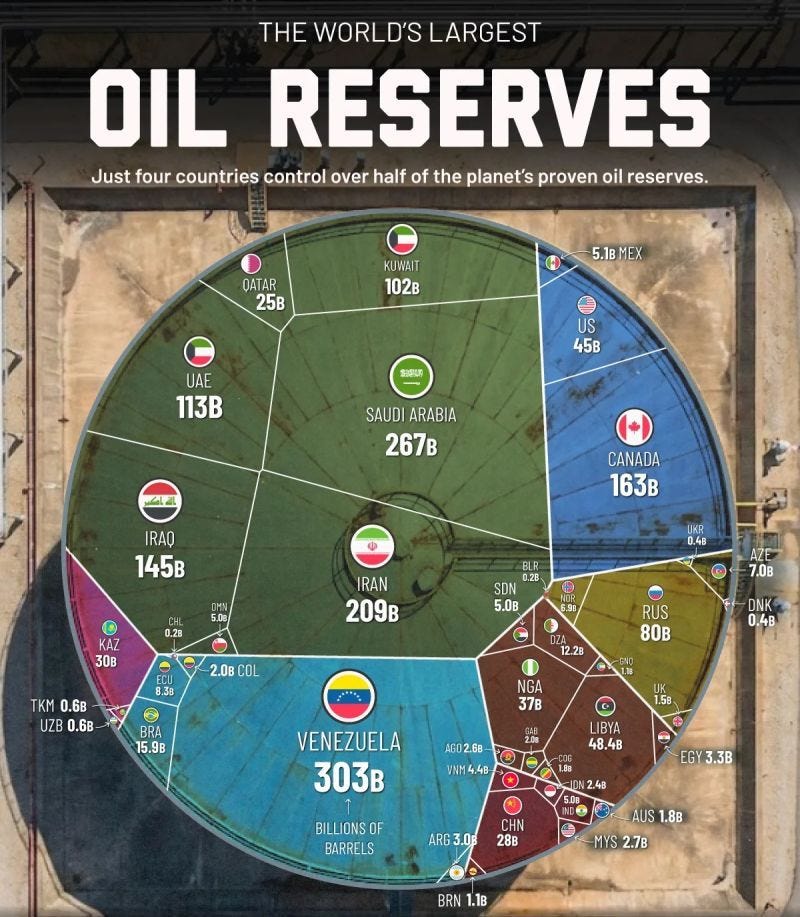
If you look at reported “proven reserves,” Venezuela dominates:
Venezuela: 303 billion barrels
Canada: 163 billion barrels
That 80% gap sounds decisive. It’s also misleading.
Both countries sit on ultra heavy, high sulfur crude with nearly identical characteristics.
🇨🇦 Alberta Oil Sands vs 🇻🇪 Orinoco Belt:
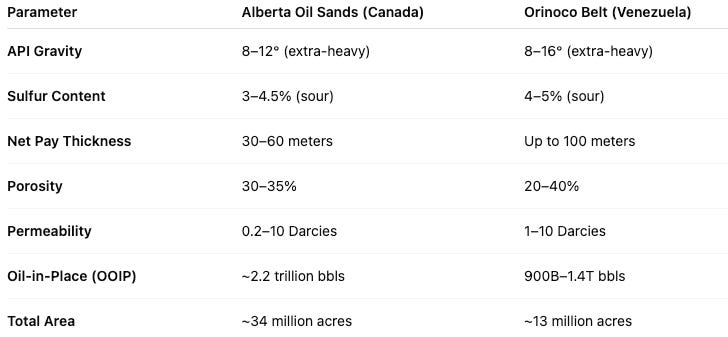
Alberta’s oil sands contain more total oil than Venezuela’s Orinoco Belt… Significantly more.
So why do the reserves tell a different story?
Because Venezuela uses OPEC style accounting, and Canada uses SEC rules.
Under SEC standards, you can only book reserves that are economically recoverable at current prices with demonstrated production. Conservative, verifiable, real.
Under OPEC national reporting, you can book volumes recoverable under foreseeable conditions a phrase elastic enough to drive a supertanker through.
Venezuela’s reserve reporting tells you everything:
2005: 80 billion barrels (pre-Chavez baseline)
2010: 220 billion barrels (+175% with minimal field development)
2015: 300 billion barrels (+275% during economic collapse)
During that 275% reserve growth, Venezuela’s production fell from 3 million bpd to under 1 million. No major drilling, No enhanced recovery projects, No geological discoveries.
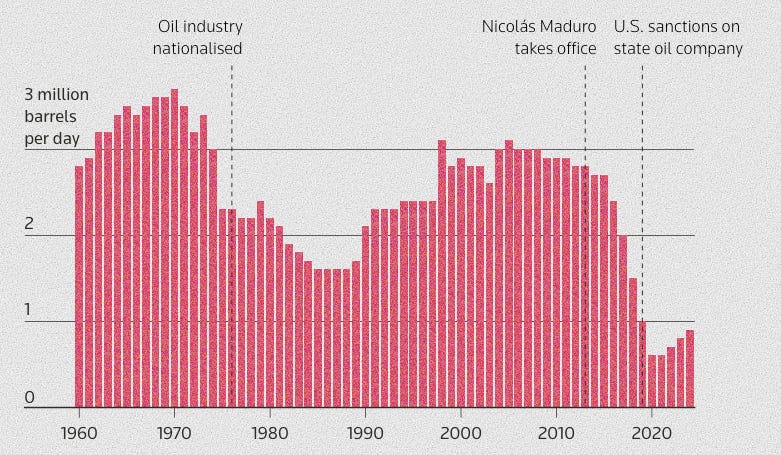
This was an accounting exercise, not a subsurface find.
If Canada applied OPEC-style booking, Alberta’s 2.2 trillion barrels in place would arguably be the world’s largest oil reserve. But they don’t and that perception gap is about to become a market gap.
The geological reality favors Canada. The economic reality just shifted to Venezuela.
Distance to the US Gulf Coast:
Alberta to USGC: 2,800+ miles via multi-stage pipeline
Venezuela to USGC: 1,500–2,000 miles via direct tanker
That 30–40% shorter distance matters… A lot.
The US Gulf Coast hosts 5 million bpd of total refining capacity, with 2.5–3 million bpd of complex coking capacity specifically designed for heavy sour crude. Many of these refineries were built in the 1970s–1990s to process Venezuelan oil.
They never forgot how.
Current confirmed USGC capacity for Venezuelan crude (February 2026):
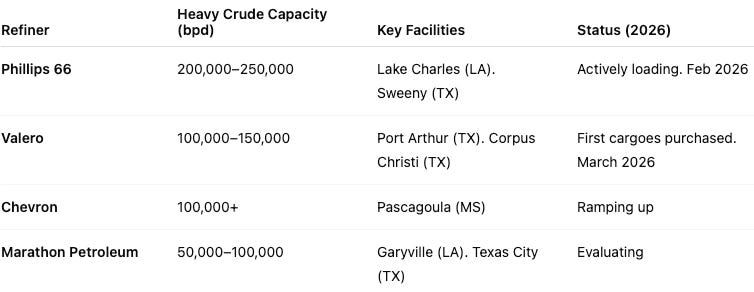
Total capacity: 450,000–600,000 bpd
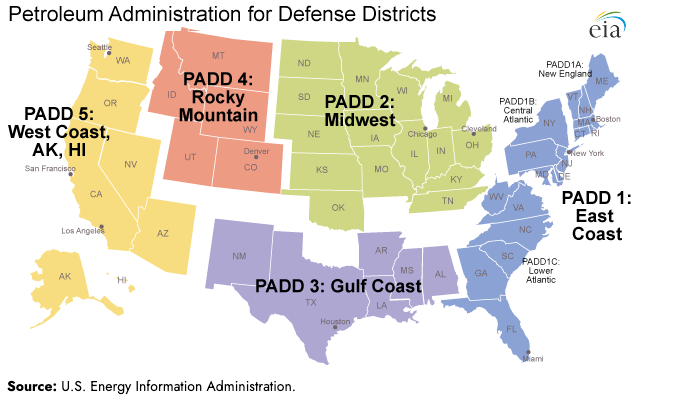
Analysts estimates PADD 3 can absorb 300,000–400,000 bpd of incremental Venezuelan crude without major capital investment.
That volume would directly displace Canadian Western Canadian Select (WCS) barrels.
And then there’s the pricing.
As of February 2026:
Venezuelan Merey-16: $6.00/bbl discount to Brent
Canadian WCS: $12.50/bbl discount to Brent
Venezuela is $6.50/bbl cheaper than Canada for the exact same refinery infrastructure. Both require coking units. Both are high-sulfur heavy crude. Both fit the same processing plants.
For US Gulf Coast refiners, the math is brutal:
Same refinery compatibility
$6.50/bbl lower feedstock cost
Shorter shipping distance (lower logistics cost)
No pipeline tariffs (marine delivery versus multi-stage pipeline)
Why would you pay more for Canadian barrels when Venezuelan crude is cheaper, closer, and fits the same equipment?
Then politics made it worse.
The last year US-Canada trade crisis fundamentally altered competitive dynamics in ways most energy analysts haven’t internalized.
Timeline:
December 2025: Canada signs EV deal with China. Trump threatens 100% tariffs on ALL Canadian imports.
January 2026: US threatens to ground Canadian aircraft, block the Detroit-Windsor bridge. Energy tariffs narrowed to 10% (versus 25% on other goods).
February 2026: Steel and aluminum tariffs doubled to 50%. Venezuela sanctions fully lifted.
US Energy Secretary Chris Wright’s rhetoric was unsubtle: “Venezuela enhances US supply lines in our hemisphere”
In a forced choice between Canadian and Venezuelan barrels, Washington now favors Caracas.
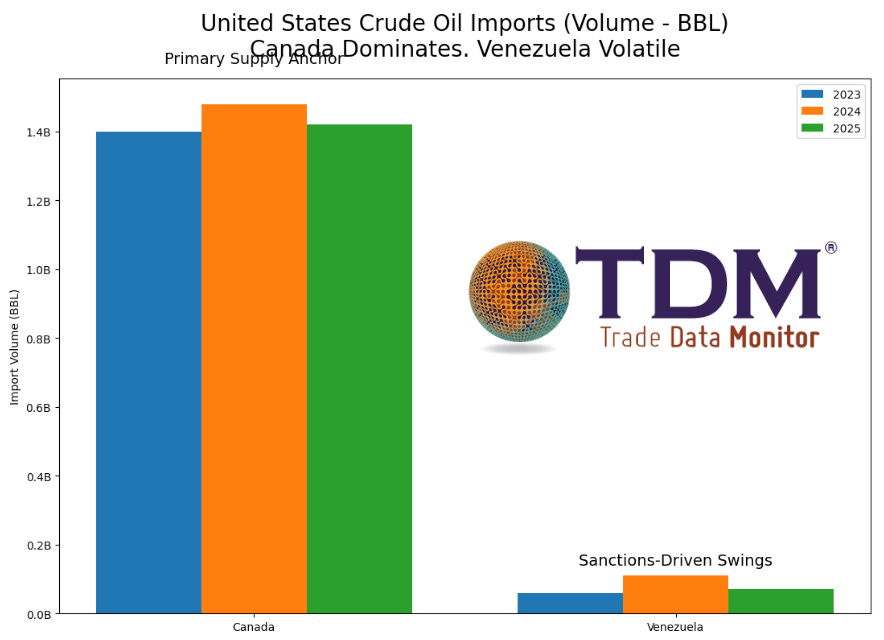
This isn’t just about price. It’s about reliability, geopolitical alignment, and what happens when your largest customer starts viewing you as “unreliable” because you’re pivoting toward China.
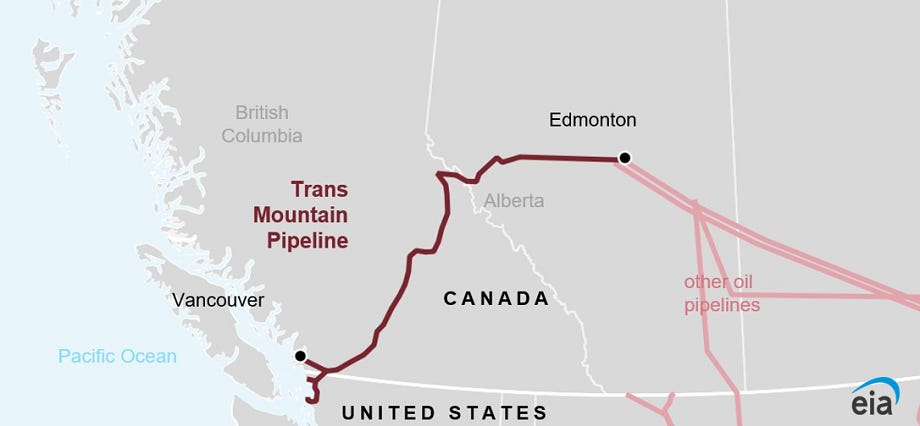
Canada’s pivot to Asia via the Trans Mountain Expansion (TMX) pipeline helps but that capacity serves PADD 5 (West Coast) and Asian markets, not the Gulf Coast refineries where the displacement is happening.
Let’s quantify the risk.
Canadian oil exports by destination (2023–2025):
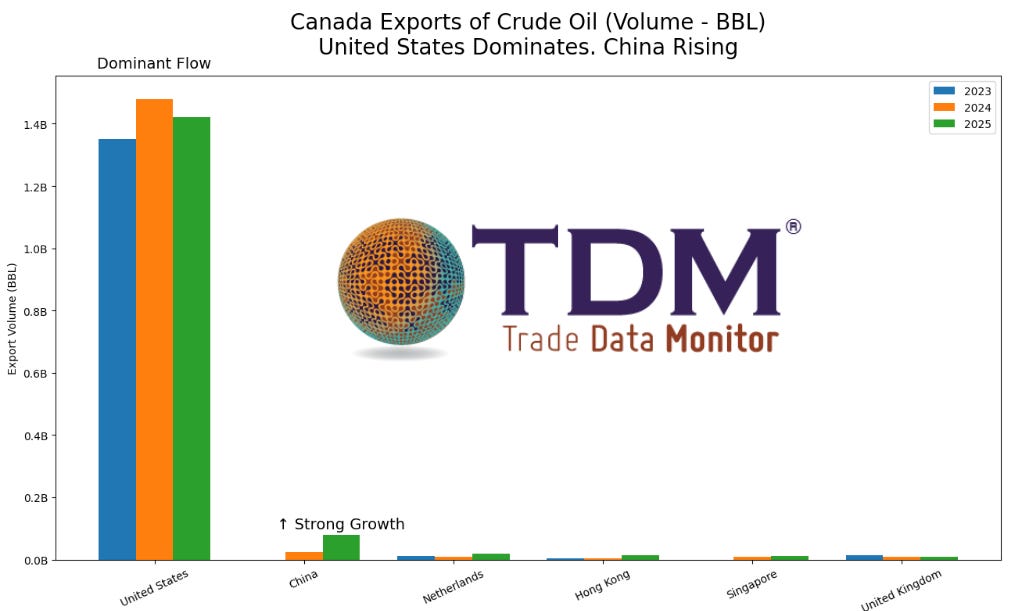
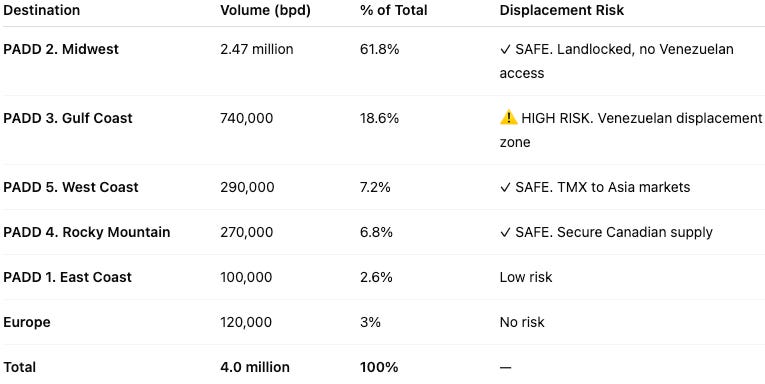
The math on PADD 3 exposure:
740,000 bpd Canadian exports to US Gulf Coast
At $74/bbl average (2025 WCS pricing) = $20 billion annual revenue
Venezuelan displacement scenario (2027–2028):
If 300,000–400,000 bpd of Venezuelan crude displaces Canadian barrels, that’s $8–11 billion in annual revenue loss.
Texas and Oklahoma alone consumed 575,000 bpd of Canadian heavy crude in 2024. That volume is now contestable.
PADDs 2, 4, and 5 remain secure 3.03 million bpd flows to the Midwest, Rockies, and West Coast via pipeline infrastructure Venezuela cannot access. TMX opened Asian export markets for PADD 5 volumes.
But PADD 3 displacement is real: 10–15% of Canada’s total exports and $10–14 billion in annual revenue face structural risk.
The market hasn’t priced this in. Canadian producers are trading like it’s business as usual. It’s not.
Why Everyone's Watching the Wrong Companies?
Which is the forgotten equipment supplier trading at a 45% discount to peers with $3 billion in addressable Venezuelan sales ?👇
